

Contract furniture involves designing, selecting, or manufacturing furniture tailored to the needs of commercial spaces such as hotels, restaurants, and stores. These projects take into account aspects such as design, functionality, durability, maintenance, dimensions, and technical requirements, and can range from space planning to manufacturing, logistics, and installation. Their primary goal is to create durable, functional solutions that align with the identity and needs of each establishment.
What Is a Contract Project?
If you’re wondering what “contract” means, it’s a term derived from the English word “contract” that the industry uses to refer to custom-designed furnishings for professional or public spaces. A contract project is, therefore, a commission to furnish a space, in which the furniture is designed, selected, adapted, or manufactured with the specific needs of the establishment in mind.
The term “contract” does not refer solely to furniture. The project may include a space analysis, aesthetic definition, material selection, manufacturing, logistics, and—depending on the scope—installation and coordination with other professionals.
Phases of a contract project
Typically, the process begins with an analysis of the space and the business’s needs. Furnishing hotel rooms is not the same as furnishing a restaurant terrace or a store with a high customer turnover.
From there, the following are usually defined:
- Layout and functional requirements: number of pieces, dimensions, traffic flow, and use of each area.
- Design: materials, finishes, colors, and alignment with the establishment’s identity.
- Technical specifications: durability, maintenance, material performance, and specific project requirements.
- Budget: cost estimates for manufacturing, transportation, installation, and other services.
- Samples or prototype: production of a test piece or finish samples to validate the design, measurements, and performance before manufacturing all units.
- Manufacturing and quality control: production of the pieces according to the agreed-upon specifications.
- Logistics and installation: coordination of deliveries and assembly at the establishment.
For larger-scale projects, it may also be necessary to coordinate the furniture with architects, interior designers, engineering firms, contractors, installers, or purchasing managers. In these cases, a turnkey project allows for the design, construction, manufacturing, and installation to be managed by a single point of contact.
Contract Furniture: Who Is Involved in the Project
Various professionals may be involved in a contract project. The business owner or manager typically defines the operational and budgetary needs, while architects and interior designers may establish design criteria and specifications.
Furniture manufacturers, distributors, installation companies, and other specialized suppliers may also be involved.
Unlike the purchase of standard furniture, in a contract project each piece must fit into the space and meet predefined requirements.
Contract Furniture vs. Standard Furniture
The main difference between contract furniture and standard furniture isn’t necessarily in their appearance. A piece of contract furniture can have a design that’s just as homey, decorative, or sophisticated as any catalog item.
In a contract project, special attention is paid to durability, stability, finishes, maintenance, and the availability of replacement parts.
These are the main differences between the two types of furniture:
| Criterion | Contract Furniture | Standard Furniture |
| Design | It can be just as decorative or sophisticated as a catalog item | Closed Catalog Design |
| Dimensions and Finishes | They adapt to the space and the establishment’s identity | Predefined sizes and finishes |
| Durability and Stability | They are specified according to their intended professional use | They aren’t always designed for heavy-duty use |
| Maintenance and Replacement | Cleanliness, maintenance, and the availability of replacement items are taken into account | Subject to catalog availability |
Required Materials and Certifications
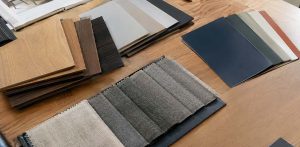
The materials used in commercial furniture are selected based on the intended use of each piece. Metal frames, wood, panels, laminates, upholstery, paints, varnishes, and other components may require specific specifications.
For upholstered pieces, for example, it is advisable to check the fabric’s abrasion resistance—which is typically measured using the Martindale test—as well as how easy it is to clean. For tables, counters, and work surfaces, on the other hand, the resistance of the finishes to scratches, stains, and moisture becomes more important.
For certain projects, certificates, test reports, or technical documentation attesting to specific product characteristics may also be required. These requirements are not the same for all furniture or for all establishments: they depend on the furniture’s use, location, the project, and applicable regulations.
Before selecting a product, it is important to verify what documentation the project actually requires and not to assume that a certification is necessary in all cases.
Maintenance should also be taken into account. In the hospitality industry, for example, an easy-to-clean finish can have a significant operational impact over the furniture’s useful life.
Contract Furniture: Applicable Regulations
The regulations that apply to a facility depend on factors such as its activity, location, spatial characteristics, and type of installation. In Spain, in addition to national regulations, there may be regional and municipal requirements. There is no single set of contract regulations that applies universally to all contract furniture.
In public spaces, factors such as fire safety, accessibility, evacuation, facilities, conditions of use, and security, among others, may come into play. The Technical Building Code, through its Basic Document SI (fire safety), establishes, for example, that in establishments open to the public, such as restaurants or cafes, curtains and other hanging textiles must meet a specific fire reaction class, and that upholstered armchairs and fixed seats in movie theaters, theaters, or auditoriums must pass specific flammability tests.
The project manager must determine which requirements apply to the specific establishment and request the relevant technical documentation from the manufacturer or supplier when necessary.
Contract Furniture for Hotels
Hotels have very different needs depending on the area to be furnished. Guest rooms, common areas, the front desk, restaurants, lounges, hallways, and outdoor spaces may require different solutions.
In guest rooms, for example, the furniture must blend in with the interior design and withstand repeated use by different guests. Beds, nightstands, desks, closets, headboards, and other accessories must meet both aesthetic and functional criteria.
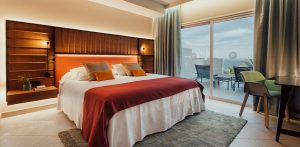
In common areas, other factors become important, such as foot traffic, durability under continuous use, ease of maintenance, and visual consistency across different areas.
Contract furniture for hotels can also be a good option when a large number of units need to be manufactured with specific dimensions, finishes, or features. Coordinated manufacturing helps maintain a consistent look throughout the entire establishment, as you can see in some of our hotel projects.
Contract Furniture for the Hospitality Industry
Restaurants, cafes, bars, and other hospitality establishments subject their furniture to particularly demanding conditions.
Tables and chairs may be used for many hours and by a large number of people. In addition, cleaning and maintenance tasks are part of daily operations.
In this context, contract furniture for the hospitality industry must be evaluated with several factors in mind:
- Resistance to intensive use.
- Ease of cleaning and maintenance.
- Stability and safety.
- Ergonomics and comfort.
- Ability to replace or restock.
- Suitability for the available space.
- Consistency with the establishment’s concept.
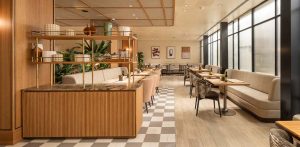
In a restaurant, the layout of the furniture has a direct impact on the flow of customers and staff. In fact, Basic Document SI of the Technical Building Code uses a ratio of one person per 1.5 m² in seating areas of bars, cafes, and restaurants as a reference for calculating the occupancy of the premises, which serves as the basis for sizing hallways and emergency exits. For this reason, choosing a table or chair based solely on its appearance may not be enough.
The furniture must fit within the establishment’s overall aesthetic and meet the actual needs of the business. In our restaurant design projects, we demonstrate how these two criteria are balanced in real-world spaces.
Furniture for Commercial Spaces
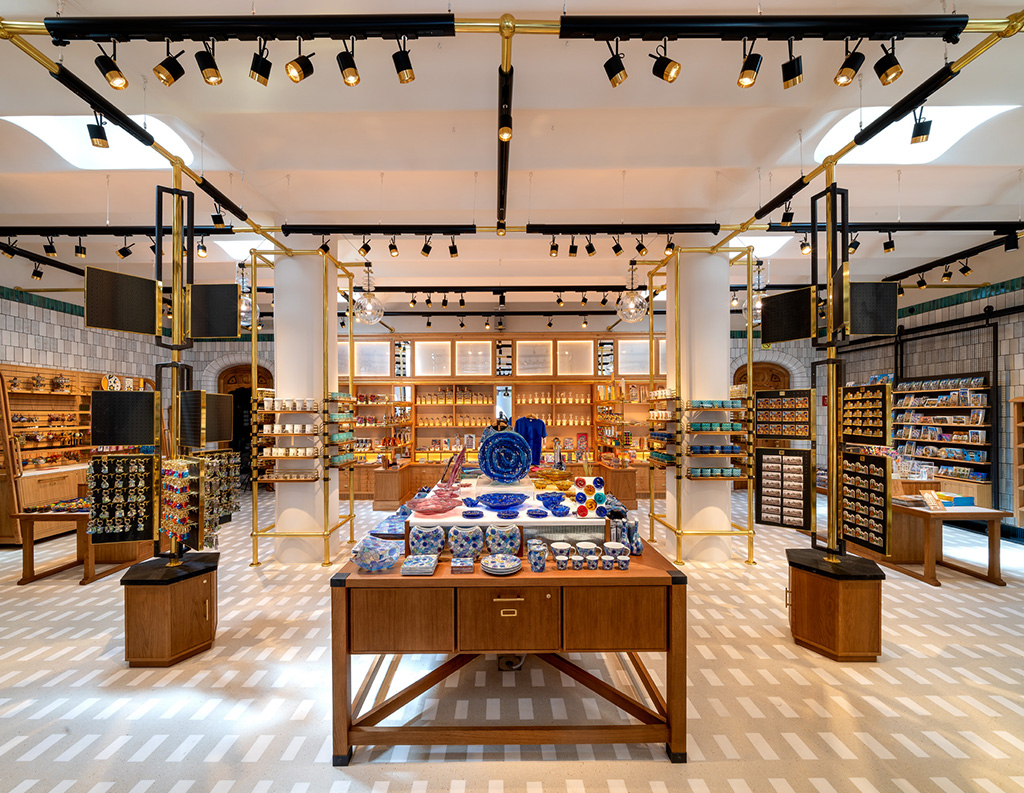
Retail presents a different set of needs. In a store, furniture does more than simply furnish the space—it also helps showcase products and guide the customer’s path through the store.
Counters, display units, shelves, accent furniture, and storage solutions can be designed to fit the dimensions of the space and align with the brand’s identity.
Furniture for retail spaces may also require a certain degree of flexibility. A store may periodically change its display, introduce new collections, or modify the layout. In these cases, it’s advisable to consider solutions that allow the space to be reorganized without having to replace all the equipment.
When dealing with a chain of stores, the project may involve even more variables: replicability, consistency across locations, ease of transport, installation times, and the ability to produce new units when a new store opens. Some of our retail projects are specifically designed for this type of implementation.
Contract Outdoor Furniture
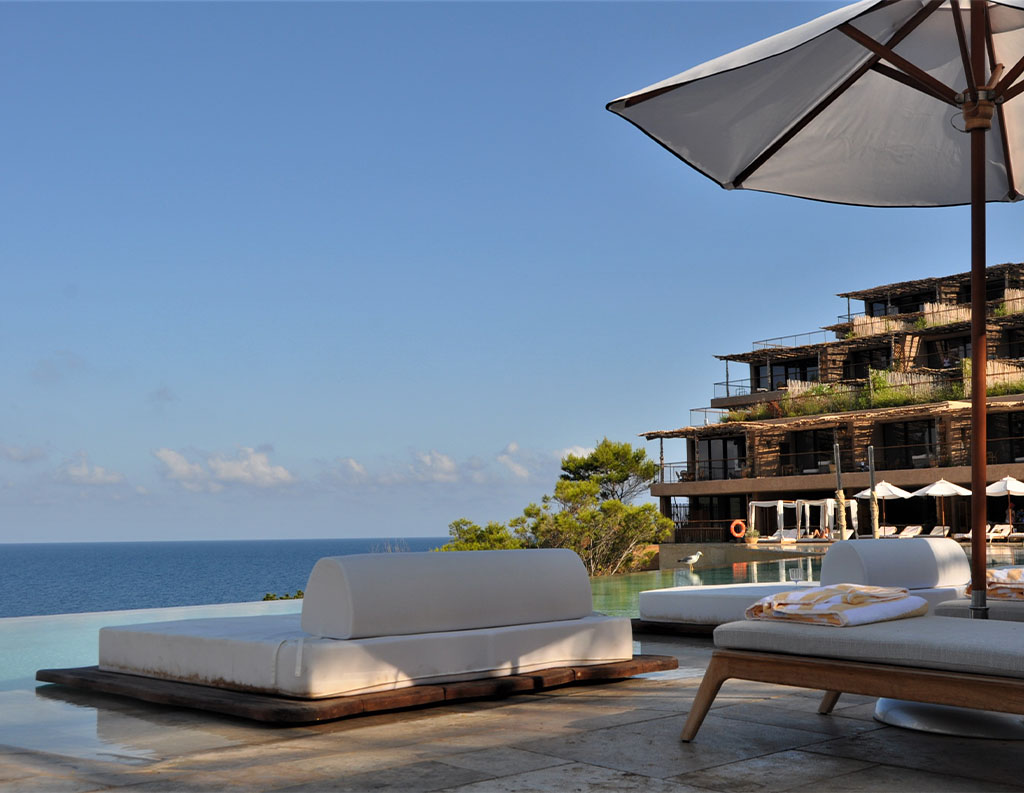
Furniture intended for terraces, patios, gardens, and other outdoor spaces is subject to conditions that differ from those found indoors.
Sunlight, humidity, temperature changes, rain, and exposure to marine environments can affect materials and finishes. Therefore, contract outdoor furniture must be selected with the specific installation conditions in mind.
It is not enough for a piece to be suitable for indoor use. For outdoor use, you must check the product’s specifications, the manufacturer’s recommendations, and maintenance requirements.
On a hospitality terrace, the weight and ease of handling of the pieces can also be important. If the furniture must be cleared away every day, stacked, or moved, these characteristics can have a direct impact.
Custom Furniture: When It’s Worth It
Custom-made furniture can be especially useful when the dimensions or characteristics of a space make it difficult to use standard products.
A space with pillars, uneven floors, irregular walls, limited space, or specific storage needs may require custom-made solutions.
It can also be beneficial when seeking a very specific aesthetic identity. A counter, headboard, bench, or display cabinet designed for a specific project can integrate better into the space than several standard pieces.
The decision should be based on a number of factors: how well it fits the space, the number of units, budget, timeline, durability, and maintenance requirements.
When Is Contract Furniture the Right Choice?
Contract furniture is particularly well-suited when the professional use of the space requires special attention to durability, functionality, uniformity, and technical specifications.
It can be a particularly attractive option when:
- The furniture will be subject to heavy use.
- A large number of identical or coordinating units are needed.
- The project requires specific finishes or dimensions.
- The furniture needs to be integrated into a renovation or construction project.
- There are technical requirements or documentation that must be verified.
- The establishment’s image is an important element of the project.
- The furniture must be adapted to specific conditions of use or maintenance.
To make the decision, it is advisable to analyze the intended use, the number of users, the frequency of cleaning, environmental conditions, technical requirements, the budget, and the expected useful life.
Every contract project has different requirements in terms of use, materials, finishes, and manufacturing. At Grupo Malasa, we develop custom furniture for hotels, restaurants, commercial spaces, and other professional settings. If you have a project in the works, please contact our team and let us know what you need.