

If you’re designing a new building or renovating an existing one, you’ve probably already been asked whether it will be certified. BREEAM certification is one of the most widely recognized sustainability labels in Spain, but exactly what it assesses, who issues it, and what it takes to obtain it isn’t always clear when a project begins. Here, we’ll review the categories assessed by the method, how the score translates into BREEAM levels, the steps involved in the certification process, and the documentation and deadlines involved—for both new construction and existing buildings.
What Is BREEAM Certification?
BREEAM (Building Research Establishment Environmental Assessment Methodology) certification is one of the methods for assessing and certifying sustainability in building construction and one of the most technically advanced.
It was established in 1990 in the United Kingdom, and BREEAM subsequently expanded to other countries, arriving in Spain in 2010 through an agreement with the ITG technology center. It is a private, voluntary certification that evaluates 10 different categories: management, health and well-being, energy, transportation, water, materials, waste, sustainable land use, pollution, and innovation.
Who issues the stamp?
The BREEAM methodology is owned by the British organization BRE (Building Research Establishment), but in Spain, certification is managed exclusively by BREEAM ES, which is operated by the Galician Institute of Technology (ITG), as we mentioned earlier.
The entire assessment process must be carried out by a BREEAM-accredited assessor, who acts as an independent consultant and auditor for the project. Their task is to gather the necessary evidence and manage the certification process with the organization.
BREEAM Compared to Other Certifications
The BREEAM certification shares common objectives with other environmental certification systems such as LEED and VERDE. BREEAM stands out for several distinctive features, such as being adapted to each country’s regulations, conducting a comprehensive assessment of the building, and considering the entire life cycle of the asset. Another distinctive feature is that it does not apply a single method to all projects, but rather offers specific schemes based on the type of property and its life cycle stage:Nueva Construcción: edificios no residenciales de nueva planta, rehabilitaciones y ampliaciones, tanto en fase de diseño como en post-construcción.
- Housing: new, rehabilitated, or renovated residential projects.
- In Use: existing buildings that are currently in operation.
- Urban Planning: Urban Development and Planning, Beyond the Single-Family Home.
- Custom: projects whose characteristics do not fit into any of the categories listed above.
The choice between one certification and another will depend on the type of project, the developer’s objectives, and the requirements of investors or clients.
| Score | BREEAM | LEED | GREEN |
| Origin and geographical scope | United Kingdom, with adaptations to different countries | The United States, with international reach | Spain, adapted to the national context |
| Evaluation approach | Comprehensive assessment of the sustainability of the building and its surroundings | Efficiency, sustainability and construction. | Environmental impact assessment throughout the life cycle |
| Project typologies | New construction, housing, existing buildings, urban planning and custom projects | New construction, existing buildings, housing and urban developments | Primarily building projects, with tools adapted to different situations |
| Main aspects evaluated | Energy, water, materials, waste, transport, health, ecology and management | Energy, water, materials, indoor environmental quality and innovation | Energy, water, materials, waste, environmental quality, mobility and biodiversity |
| Main competitive advantage | Flexibility and adaptation to the local context | International recognition and standardization | Adaptation to the Spanish context and approach to environmental impacts |
What Does BREEAM Measure?
This certification evaluates a building’s environmental performance and sustainability across ten main categories. Each category contributes a set of credits that determine the final score.
Assessment Categories
The categories analyzed by BREEAM are:
- Management: planning, monitoring, and best practices during the project and construction phases.
- Health and Well-being: thermal comfort, lighting, indoor air quality, and acoustics.
- Energy: energy efficiency, emissions reduction, and use of renewable energy.
- Transportation: accessibility, sustainable mobility, and connectivity to services.
- Water: reduction of consumption and efficient management of water resources.
- Materials: environmental impact of the materials used.
- Waste: prevention, separation, and recycling of waste.
- Ecological land use: protection and enhancement of biodiversity.
- Pollution: reduction of environmental impacts and emissions.
- Innovation: recognition of advanced sustainable solutions.
Weight for each category
Each category is weighted differently in the final score. Areas related to energy, health, materials, or management typically carry significant weight, although the exact weighting will depend on the BREEAM scheme used and the type of building.
BREEAM Levels and Scores
The assessment results in a rating that reflects the building’s level of sustainability. The highest levels require a comprehensive approach to sustainability starting in the early design phases, as well as proper execution and documented justification of the project.
| Score | BREEAM Level |
| ≥ 30 % | Pass |
| ≥ 45 % | Good |
| ≥ 55 % | Very Good |
| ≥ 70 % | Excellent |
| ≥ 85 % | Outstanding |
How to Obtain the Certificate
Obtaining BREEAM certification requires planning from the start of the project and the involvement of an accredited consultant, as we mentioned earlier.
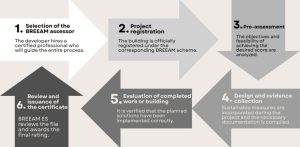
Stages of the Process
- Selection of a BREEAM consultant; the developer hires an accredited professional to guide the entire process.
- Project registration; the building is officially registered under the applicable BREEAM program.
- Preliminary assessment: The objectives and feasibility of achieving the desired score are analyzed.
- Design and evidence gathering; throughout the project, sustainable measures are incorporated and the necessary technical documentation is gathered.
- Inspection of a completed construction project or building; this verifies that the planned solutions have been properly implemented.
Review and issuance of the certificate; BREEAM ES reviews the application and awards the final rating.
Documentation and Deadlines
The required documentation may vary depending on the type of building, the chosen BREEAM scheme, and the certification phase, but it typically includes technical evidence demonstrating that the assessed requirements have been incorporated into the project and properly implemented.
- Technical design and drawings.
- Energy reports and calculations.
- Certificates and environmental data sheets for materials.
- Studies related to water consumption and management.
- Waste management plans and environmental management plans for the construction project.
- Documentation on mobility, air quality, and user comfort.
- Photographs, reports, and records documenting the solutions implemented during construction.
Estimated cost of the certificate
The cost of BREEAM certification is not fixed, as it depends on the characteristics of each project, such as the building’s floor area and complexity, the property’s use and type, and the certification level to be achieved.
It is recommended to request a specific assessment at the start of the project, when it is still possible to analyze which level you want to achieve and what measures will be necessary to do so.
Benefits for the Owner
BREEAM certification not only verifies a building’s level of sustainability, but it can also provide benefits during its operation and improve its standing in the real estate market. Some of the main advantages for the owner are:
- Reduced energy and water consumption, thanks to the implementation of measures aimed at improving the building’s efficiency.
- Lower operating and maintenance costs, especially when efficiency strategies are incorporated from the design phase.
- Improved comfort and well-being for occupants through factors such as air quality, lighting, thermal comfort, and sound insulation.
- Increased value and appeal of the property, thanks to a recognized certification that attests to its commitment to sustainability.
- Greater appeal to investors, buyers, and tenants, especially in a market where environmental criteria are playing an increasingly important role in decision-making.
In addition, certification can help organizations stay ahead of new regulatory and market requirements related to energy efficiency, emissions reduction, and the decarbonization of the building stock.
BREEAM for Existing Buildings
As we have already seen, this certification is not limited to new construction. The BREEAM In-Use scheme is used to assess existing buildings that are already in operation, such as offices, hotels, or residential buildings.
Certification must be renewed periodically, which promotes continuous improvement in the asset’s performance.
This system analyzes both the physical characteristics of the building and its management and operation, identifying opportunities for improvement and facilitating a reduction in energy consumption and environmental impacts.
If you’d like to learn more about the criteria, levels, and different certification schemes, please visit the official BREEAM website. And if you’re working on a project and would like to know how Grupo Malasa can help you, please contact us through iour contact page.